How to Select the Best Fluid Film Journal Bearing for Your Application

Matching bearing design to speed, load, and lubrication requirements.
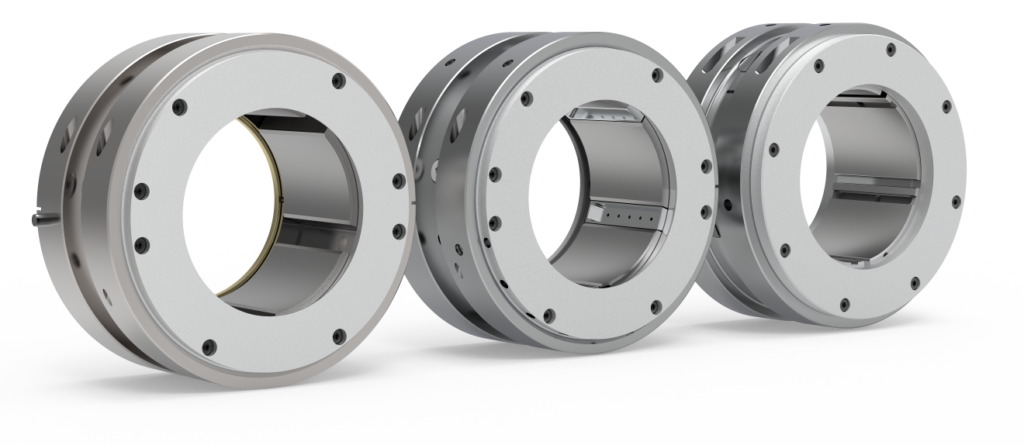
PJ Flooded Lubrication Tilting Pad Journal Bearings
Tilting pad journal bearings with flooded lubrication are ideally suited for a wide variety of applications with moderate speeds, usually up to 70 m/s.
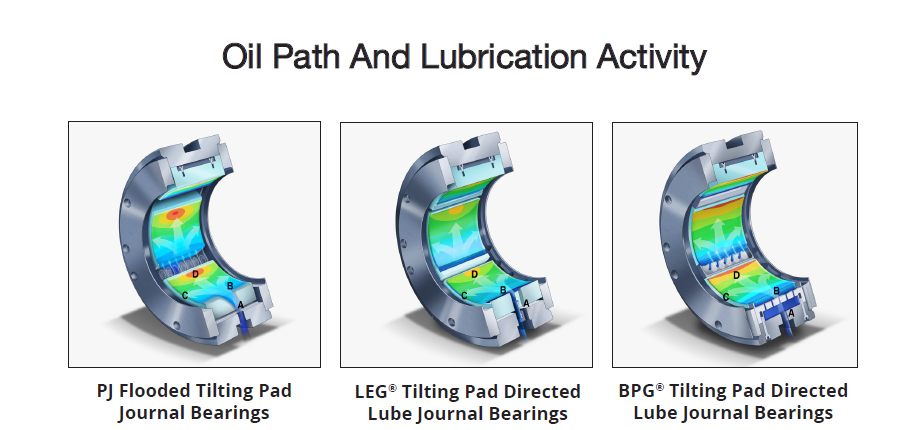
Laterally attached end shields or floating rings ensure that the inside of the bearing is flooded with oil due to the resulting minimum inside pressure. The required oil flow can be regulated in the supply through orifices in the annulus machined into the outside of the aligning ring or in the discharge through sealing gaps and outlet holes. The rotating shaft carries the oil surrounding the pads across the sliding surface of each pad, forming a wedge-shaped film that has tremendous load carrying capability.
The flooded type of lubrication has advantages in the event of an unexpected interruption in the oil supply or vibration problems that could arise due to oil starvation seen with other lubrication types. However, there can also be disadvantages, especially at higher speeds than recommended above, due to very high bearing temperatures and power losses caused by the poor mixing factor between freshly supplied oil and the circulating hot oil film. It is under these operating conditions where a direct- lubricated design such as LEG® or BPG® would provide more benefit.
LEG® Directed Lubrication Tilting Pad Journal Bearings
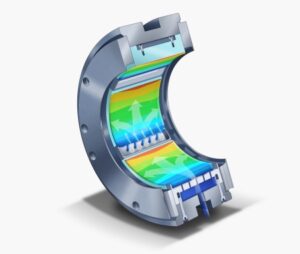
Kingsbury’s patented LEG® journal bearings offer directed lubrication through Leading Edge Grooves incorporated at the beginning of the pads. These are connected by oil feed tubes to the annulus machined into the outside of the aligning ring where oil distribution occurs.
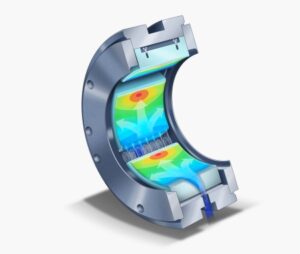
LEG® bearings are ideally suited for a wide range of applications with moderate to high speeds up to 110 m/s. They have the most effective direct lubrication method as the fresh oil goes straight into the lubrication gap, as shown in the following graphs. As a result, the oil requirement is reduced to almost the hydrodynamic oil flow, and the mixing factor between freshly supplied oil and the circulating hot oil film is close to 90%, the highest compared to all other types of lubrication.
Applications have proven that advanced LEG® bearings can substantially reduce oil consumption, power loss and bearing temperatures and thus significantly increase load capacity.
LEG® bearings are usually designed with a pad pivot offset of 60% of its effective length and can only be operated in one direction of rotation when fully loaded. Up to a certain load value, they can also be operated in the opposite direction. However, these limits must be calculated and approved by Kingsbury. When using end plates, the bearing should have a bottom drain so that the cavity remains evacuated, which is essential to achieving the bearing’s advantages.
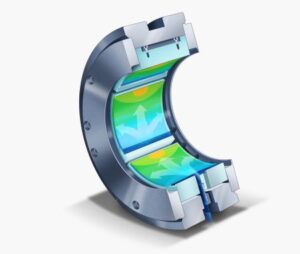
BPG® Directed Lubrication Tilting Pad Journal Bearings
The patented BPG® stands for “Between Pad Groove” and is ideally suited for a wide range of applications with moderate to high speeds up to 120 m/s.
BPG® Tilting Pad Journal Bearings have a directed lubrication type using Kingsbury’s distinctive oil feed bar placed between the pads.
Like our LEG® (Leading Edge Groove) bearings, the BPG® is designed to introduce cool oil from the groove directly into the load-carrying lubricating film. Due to the proprietary shape of the oil feed bar, an efficient oil supply in terms of oil consumption and cooling effect in the leading-edge area of the pad will be achieved. The BPG® provides very good static as well as dynamic properties in turbomachinery applications. According to our own test bench investigations, the BPG® also has a positive influence on the temperature profile in the laminar-turbulence transition regime.
Compared to a flooded bearing, the BPG® consumes significantly less oil resulting in a sharp drop in power losses also due to the elimination of parasitic losses. Furthermore, there is a corresponding reduction in operating temperatures, varying by 8° to 28° C, contingent on the load and shaft speed. When using end plates, these should have a bottom drain so that the cavity remains evacuated, which is essential to achieving the mentioned advantages.
Kingsbury’s Tilting Pad Journal Bearings
As rotating machinery has evolved, many types of bearings have come and gone. Today, rotational speeds and power density continue to increase, along with machinery complexity. The rotordynamic characteristics of these machines depend heavily on the journal bearings. A fixed‑profile journal bearing, which is inherently unstable at light loads, can experience self‑excited subsynchronous vibration during operation, a phenomenon known as oil whirl. While certain bore profile modifications have been successful in raising the stability threshold, a fixed‑profile bearing remains susceptible to damage from misalignment, imbalance, or wear.
The inherent design characteristics of a tilting pad journal bearing, on the other hand, are well suited to eliminating oil film instabilities, regardless of where they originate. Depending on the type of pivot support, shaft misalignment can also be accommodated to a certain extent.
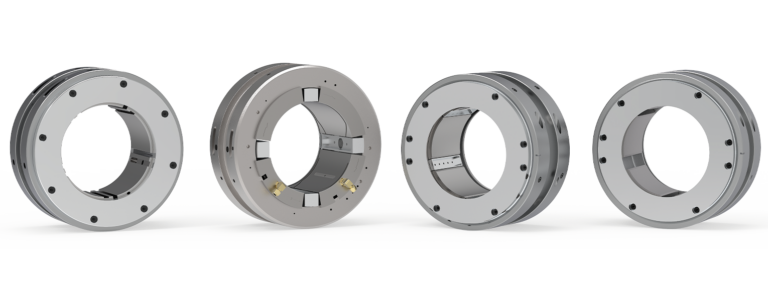
All tilting pad journal bearings from Kingsbury’s standard platform share the same housing fit dimensions and common design features, including the pad retaining system and pad pivot style. They consist of four or five pads and are available in a wide range of width‑to‑bore ratios (L/D), including 0.4, 0.5, 0.6, 0.7, 0.9, and 1.0. Depending on the requirements of the application, LEG® and BPG® bearings can be supplied with or without end plates. When oil discharge is not a concern, the configuration without end plates minimizes the axial length of the assembly. When protection of sensitive components such as dry gas seals is required, one of two standardized end plate designs, with or without a floating seal ring, can be bolted onto the journal bearing.
In all cases, all three bearing types are designed to standard envelope dimensions used worldwide across a broad range of applications, including steam and gas turbines, gearboxes, gas expanders and compressors, and pumps.
For optimized rotordynamic performance, direct‑lubricated LEG® and BPG® bearings are designed with a standard preload factor between 0.3 and 0.35. These versatile designs offer several configuration options, including alternative pad pivot configurations to meet specific application demands, such as center versus offset pivots; line versus point contact (double radius); or ball‑and‑socket designs. Additional enhancements include anti‑SSV (sub‑synchronous vibration) grooves.
Line contact supports provide high stiffness, while point contact supports, also known as double radius supports, can accommodate shaft misalignment caused by bending or foundation deflections. Both support types are available in center and offset pivot arrangements. Compared to point contact supports, ball‑and‑socket designs provide significantly higher stiffness but may introduce instability at high speeds due to coupled dynamic coefficients.
Our tilting pad journal bearings are lined with centrifugally cast high‑tin babbitt materials such as ECKA© Tegostar™, or equivalent, as well as ASTM B23 Grade 2. Alternative lining materials, including PEEK and bronze, are available upon request. The pads and aligning rings are typically manufactured from mild steel. When elevated pad operating temperatures are anticipated, CrCu can be used as the base material to improve heat transfer.
The back of each journal pad is circumferentially contoured to mate with a corresponding radial contour in the aligning ring. This contact geometry allows each pad to respond freely to the hydrodynamic forces generated by the rotating shaft, ensuring stable and predictable operating behavior.
Our bearing designs are continually validated through in‑house testing at Kingsbury’s Research & Development Laboratory at sliding speeds of up to 110 m/s and are used by customers in commercial operation at even higher speeds. The maximum permissible speed is strongly influenced by bearing load and bore diameter. In general, smaller bearings allow lower values of speed multiplied by specific load.
For general guidance, Kingsbury recommends the following maximum permissible sliding speeds and specific loads:
• 70 m/s for flooded bearings
• 110 m/s for LEG® bearings
• 120 m/s for BPG® bearings
• 4 MPa for all three bearing types
In certain applications, allowable loads and speeds may differ from these guidelines due to other operating conditions. Kingsbury can evaluate each application using its proprietary journal bearing performance program to confirm the final selection. Key performance parameters, including oil film thickness, surface temperature, power loss, and oil flow, are evaluated against established acceptance criteria.